



In 2025, providers continued to adapt to a healthcare system that is evolving quickly. New care models gained traction. Digital tools became more embedded in day-to-day practice. Expectations around efficiency, quality, and coordination kept rising.
Throughout the year, Vim focused on one simple goal: supporting providers in the moments that matter most. Not by changing how care is delivered, but by strengthening the workflows providers already rely on.
This year in review reflects how Vim worked alongside providers in 2025, helping them move with greater clarity, confidence, and momentum at the point of care.
Putting Providers First
Everything Vim builds starts with a straightforward belief: tools are only valuable if they fit naturally into daily clinical work.
In 2025, Vim continued to expand its presence directly withinEHR workflows, enabling providers to access payer insights, care gaps, referrals, documentation support, and third-party applications without stepping outside the chart.
One example came from a Humana pilot focused on surfacing CMS-accepted condition alerts directly inside provider workflows. Over a 180-day period, more than 8,000 alerts were delivered to clinicians supporting approximately 3,500 members. Providers closed 23 percent of those gaps at the point of care during the pilot, without relying on separate portals or manual file review.
For participating care teams, the difference was not just access to information, but access at the right moment, during the visit, when impact was most important.
Turning Insight Into Action at the Point of Care
Knowing what to do is only half the challenge. Acting on that information during a clinical encounter is where meaningful progress happens.
Throughout the year, Vim focused on helping providers translate insight into action without adding friction. Care gaps surfaced when clinically relevant. Documentation and chart retrieval workflows became more predictable. Referrals moved forward without requiring providers to leave the EHR or rely on follow-up phone calls.
That approach also shaped how third-party applications showed up in care delivery.
Rula, a mental health technology company available through the Vim Connect Marketplace, addressed a challenge many primary care providers face daily: timely access to behavioral health care. Nationally, 85 percent of primary care providers (PCPs) report difficulty getting patients in front of a mental health specialist within three months. Through Rula’s embedded experience on Vim, providers can refer patients to in-network behavioral health providers as soon as the next day, with a single click inside the EHR.
Just as importantly, Rula closes the loop by sending clinical feedback back to the referring provider. That feedback helps PCPs stay informed about patient progress, rather than wondering whether a referral resulted in care.
Supporting Innovation Without Adding Complexity
As interest in AI-powered and digital health tools continued to grow in 2025, providers faced a familiar tension: innovation often arrives fragmented, requiring extra effort to adopt.
Vim addressed this by strengthening its role as a workflow technical connection layer across providers, payers, EHRs, and digital health innovators. Through the Vim platform and marketplace, providers gained access to new applications that were already embedded and context-aware.
For Rula, building on Vim Connect meant they could focus on improving access to behavioral health care rather than navigating EHR integration complexity. The ability to self-serve app configuration, test with real workflows, manage versioned releases, and preview marketplace listings streamlined the path from development to production. For providers, that translated into faster access to a new capability without added operational burden.
Enabling Performance in a Value-Driven Environment
As value-based care models matured, providers needed clearer signals and smoother execution.
In 2025, Vim supported risk-bearing organizations, such as MSOs, ACOs, and IPAs, by helping deliver actionable insights directly to care teams. The Humana pilot demonstrated how embedded alerts could replace manual gap files and support more complete documentation during everyday encounters.
At the same time, marketplace applications like Rula showed how embedded workflows can extend beyond quality and risk, supporting whole-person care by making access to healthcare’s latest innovations easier for patients and simpler for providers to initiate.
Looking Ahead
The experiences of 2025 reinforced a clear lesson: progress in healthcare does not come from more tools, but from better integration.
As Vim looks ahead, the focus remains the same. Embed support where care happens. Make it easier for providers to act in the moment. Create space for innovation without adding noise.
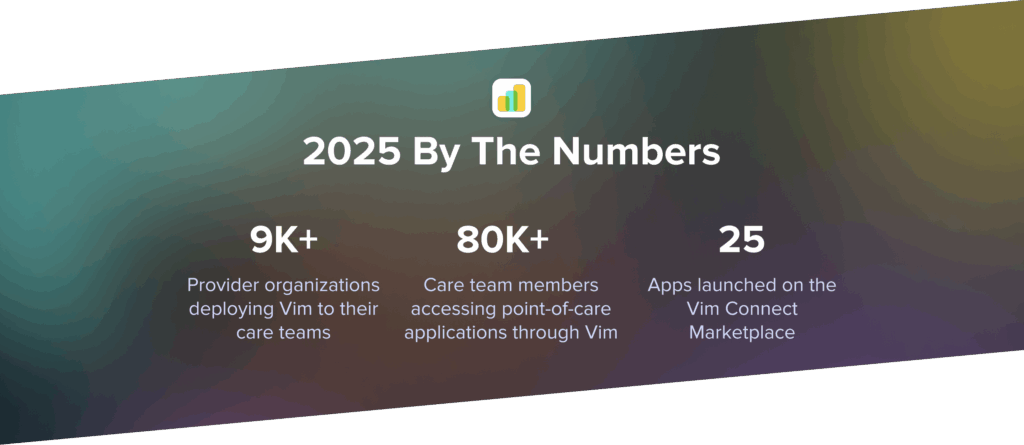
The scale reached in 2025 sets the foundation for what comes next: millions of patient encounters, tens of thousands of providers, and a growing marketplace of embedded applications.
To the providers and partners who worked alongside Vim this year, thank you for trusting us to be part of your workflow. We look forward to continuing that work together.